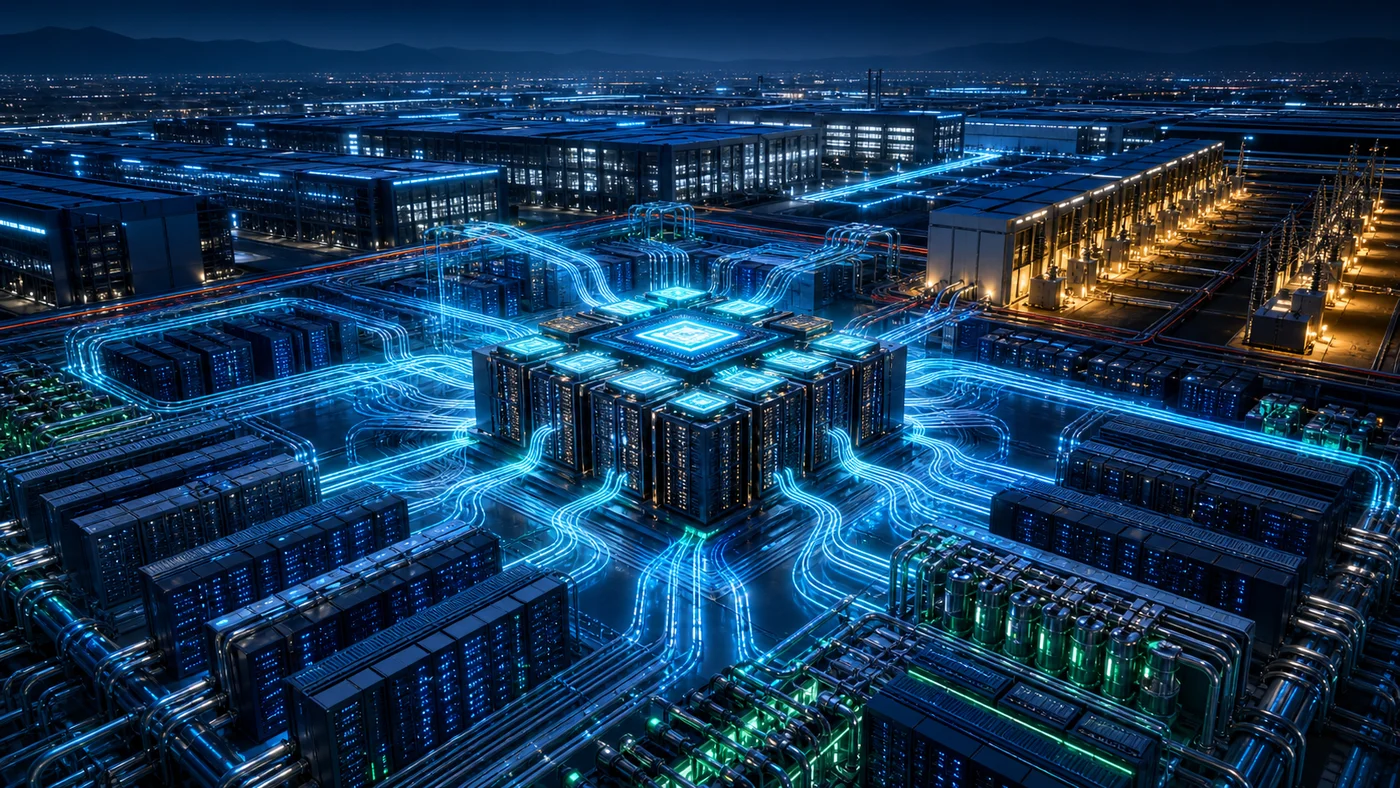
AI products may appear as simple text boxes, coding assistants, or application programming interfaces. Behind that software is an industrial-scale system of specialized processors, high-speed networks, storage arrays, cooling equipment, electrical infrastructure, and physical buildings.
Alphabet's latest spending forecast makes that connection unusually visible. Demand for AI cloud services is growing quickly enough that Google is increasing an already enormous infrastructure budget while reporting that available capacity still does not fully meet customer demand.
What Happened?
Alphabet raised its expected 2026 capital expenditures to between US$195 billion and US$205 billion. Its previous estimate was US$180 billion to US$190 billion, so both ends of the forecast increased by US$15 billion.
Google Cloud generated US$24.8 billion in revenue during the quarter ending in June, an increase of 82% from the previous year. That growth accelerated from 63% in the preceding quarter and exceeded analysts' expectations.
Alphabet finance chief Anat Ashkenazi said the company has significantly increased capacity over the past three years, but demand continues to outpace that investment. Faster-than-expected delivery of new capacity contributed to the higher spending forecast.
The quarter also marked the first time Alphabet recognized revenue from direct sales of TPU systems delivered to customer data centres. Most revenue from those agreements is still expected to arrive in 2027, but the change means Google is now monetizing some of its custom AI hardware outside the traditional model of renting cloud access.
Why It Matters
Software has always depended on hardware, but modern AI makes the dependency difficult to ignore. Training a large model may require thousands of accelerators working together for weeks or months. Serving that model to millions of users requires another large fleet that can respond quickly and reliably throughout the day.
Adding an AI feature is therefore not only a programming decision. It can create demand for additional chips, server racks, fibre connections, storage, backup power, cooling loops, buildings, and electricity contracts. Capacity may take years to plan and construct even when the software demand appears almost overnight.
The spending increase also shows the risk of a capacity bottleneck. If customers want more processing than a cloud platform can supply, workloads may wait in queues, launches may be delayed, and customers may move to another provider. If the company builds far more capacity than demand eventually requires, expensive equipment and data centres can sit underused.
What Capital Spending Builds
Capital expenditure, often shortened to CapEx, pays for assets expected to provide value over several years. For an AI cloud platform, that investment can span the complete physical stack:
- AI accelerators: TPUs and GPUs perform the matrix calculations used in model training and inference.
- Host servers: CPUs, memory, and local storage prepare data and coordinate accelerator work.
- High-speed networking: Specialized interconnects exchange model parameters and intermediate results between processors.
- Storage systems: Distributed storage holds training data, model checkpoints, application data, and backups.
- Data centres: Buildings provide controlled environments, physical security, and space for large equipment fleets.
- Power and cooling: Electrical substations, backup systems, chillers, and liquid-cooling equipment keep dense clusters operating safely.
A shortage in any one layer can limit the whole system. Owning enough processors does not help if the network cannot move data quickly enough, the power connection is delayed, or the cooling system cannot remove the heat they generate.
Connected Computer Science Concept: Distributed Systems
A distributed system is a collection of independent computers that coordinate through a network and behave like one larger system. Large AI workloads use distribution because a single processor or server cannot provide enough computation or memory.
Google groups TPUs into slices and pods connected by specialized high-speed networks. A training job can divide its work across multiple chips and host machines. The system must move data, synchronize calculations, recover from component failures, and keep expensive processors busy.
AI workloads commonly use several forms of parallelism:
- Data parallelism sends different batches of training data to several workers that share a model.
- Model parallelism divides a model across processors when it is too large for one device's memory.
- Pipeline parallelism assigns different stages of the model to different processors and moves work between them.
- Replica distribution runs multiple copies of an inference service so requests can be balanced across regions and machines.
Distribution creates scale, but it also creates overhead. Workers must exchange information, slow components can delay the group, and a network fault can interrupt a job even when most processors are healthy. Effective systems balance useful computation against coordination cost.
Why Direct TPU Sales Are Significant
A Tensor Processing Unit, or TPU, is Google's application-specific integrated circuit for machine-learning calculations. Until recently, outside customers generally consumed TPU capacity as a Google Cloud service. Direct system sales allow selected customers to operate Google-designed accelerators inside their own data centres.
That expands Google's role from cloud provider to AI-system supplier. It may also help large customers build dedicated capacity, but it requires Google to support a more complex product: chips, system design, delivery schedules, networking, software, maintenance, and integration with the customer's facilities.
Learn This Term: Capacity Planning
Capacity planning is the process of estimating how much computing infrastructure a service will need and ensuring that capacity becomes available before demand arrives. The difficult part is that hardware, buildings, and electricity have long lead times while software demand can change quickly.
A practical capacity plan considers:
- Demand: How many users, requests, training jobs, or tokens will the system process?
- Work per request: How much processor time, memory, storage, and network bandwidth does each unit of demand consume?
- Peak load: What happens during product launches, regional traffic spikes, or unusually large training runs?
- Headroom: How much spare capacity is required for failures, maintenance, and forecasting error?
- Lead time: How long will it take to order chips, connect power, construct facilities, and deploy usable servers?
- Location: Which regions need capacity to meet latency, reliability, and data-residency requirements?
- Efficiency: Can software optimization, scheduling, batching, or smaller models reduce the hardware requirement?
A Small Capacity-Planning Exercise
Imagine an inference service that currently handles 10,000 requests per minute. Product forecasts predict 60% growth next year, and the service must retain 25% spare capacity for failures and traffic spikes.
Expected demand = 10,000 × 1.60
                = 16,000 requests per minute

Planned capacity = 16,000 × 1.25
                 = 20,000 requests per minute
This estimate is only a starting point. The team would load-test the service to determine how many requests each accelerator can handle, identify memory and network bottlenecks, account for regional distribution, and compare the forecast with real usage throughout the year.
If one server safely handles 500 requests per minute, the simple estimate requires 40 servers. A real design would add redundancy across failure zones and consider whether maintenance, hardware failures, or network limits reduce the usable total.
What Engineers Should Watch
- Whether demand forecasts measure peak usage as well as averages.
- Whether processors are waiting on memory, storage, or networking instead of performing useful work.
- Whether capacity is distributed across enough regions and failure domains.
- Whether third-party capacity creates higher costs or operational dependencies.
- Whether newer models or software optimizations reduce computation per request.
- Whether power, cooling, and construction schedules match server-delivery plans.
- Whether the business value of additional capacity justifies its financial and environmental costs.
Key Takeaways
- Alphabet increased its 2026 capital-spending forecast to US$195–205 billion as AI infrastructure demand continued to exceed supply.
- Google Cloud quarterly revenue grew 82% to US$24.8 billion.
- Alphabet recognized direct TPU-system sales revenue for the first time.
- AI software depends on processors, networks, storage, data centres, cooling, and electricity working as one physical system.
- Distributed systems divide large AI workloads across many connected machines, introducing both scalability and coordination challenges.
- Capacity planning connects demand forecasts with infrastructure, redundancy, lead times, location, and efficiency.