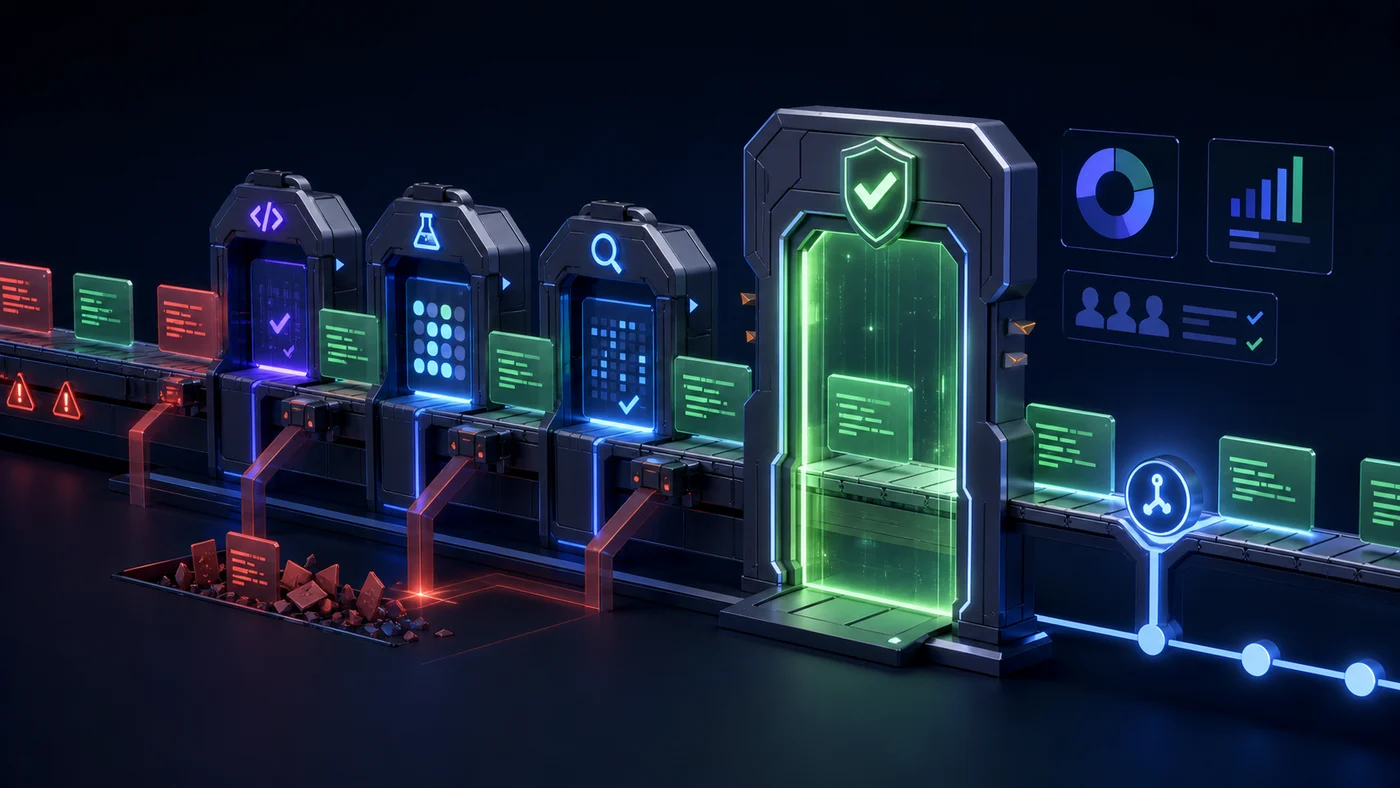
AI can help developers produce code more quickly, but a larger volume of code does not automatically create a more reliable product. Every new line can also introduce a maintainability problem, an untested path, or behaviour that becomes expensive to correct later.
GitHub Code Quality is designed for that gap. It puts automated feedback and enforceable standards beside the pull request, where developers already review and discuss changes. The goal is to identify problems before they become part of the default branch.
What Happened?
GitHub announced that Code Quality became generally available on July 20, 2026, for GitHub Team and GitHub Enterprise Cloud. July 20 is also the official date on which billing began for the generally available product.
The product combines deterministic CodeQL analysis with AI-assisted detection to find maintainability and reliability issues. Results can appear in pull requests, and Copilot Autofix can suggest changes for a developer to review before merging.
At general availability, GitHub also highlights several workflow features:
- Organization-wide enablement and dashboards for viewing quality across repositories.
- Code-coverage measurements rendered from existing Cobertura XML test reports.
- Quality gates through rulesets, including coverage thresholds and an evaluation mode for gradual adoption.
- APIs for enabling repositories and retrieving findings.
What It Costs
GitHub lists a base price of US$10 per active committer each month. An active committer is someone who has pushed to a Code Quality-enabled repository within the previous 90 days. Each person is counted once across an organization, and bot accounts are not charged.
That license is only one part of the cost. AI-assisted detection and Copilot Autofix use metered, usage-based billing, while deterministic CodeQL scans consume GitHub Actions compute. Code Quality is a standalone paid product rather than a feature bundled with GitHub Advanced Security, and it is not available on GitHub Enterprise Server at launch.
Why It Matters
Quality work is most useful when it happens close to the code change. If a developer receives feedback while a pull request is still open, the reasoning behind the change is fresh, the relevant lines are easy to locate, and the correction is usually smaller. The same issue discovered months later may require a larger investigation and a riskier fix.
Integrating findings, coverage, and merge controls also turns quality from an informal expectation into a visible part of the development process. A team can define a shared minimum and apply it consistently instead of relying on every reviewer to notice every problem manually.
Automation does not make the decision flawless. A static-analysis rule or AI-generated finding may misunderstand intent, lack runtime context, or flag code that is safe in its actual environment. Developers still need to inspect the data flow, test the behaviour, and decide whether a proposed fix is correct.
Connected Computer Science Concept: Static Analysis
Static analysis examines source code without executing the program. A tool builds a model of the code and searches for patterns that may indicate a defect, weak design, unsafe operation, or maintainability problem.
CodeQL treats code as data that can be queried. Its deterministic rules produce repeatable results: given the same code and configuration, the same analysis should identify the same pattern. AI-assisted detection can extend that process by reasoning about less rigid patterns, but its conclusions require more human judgment.
Static analysis and automated testing answer different questions. Static analysis asks what suspicious structures exist in the code. Tests execute selected paths and ask whether observed behaviour matches expectations. Neither sees everything, so strong projects use both.
Learn This Skill: GitHub Actions Quality Gates
A quality gate is a condition that must be satisfied before a change can move forward. In a small GitHub project, the first gate can be simple: every pull request must pass a linter and the automated test suite before it can merge.
Create .github/workflows/quality-gate.yml in a Node.js repository:
name: quality-gate

on:
  pull_request:
  merge_group:

permissions:
  contents: read

jobs:
  test-and-lint:
    runs-on: ubuntu-latest
    steps:
      - uses: actions/checkout@v6
      - uses: actions/setup-node@v4
        with:
          node-version: 24
          cache: npm
      - run: npm ci
      - run: npm run lint
      - run: npm test
The workflow runs when a pull request is opened or updated. It also listens for merge_group, which is important when a repository uses GitHub's merge queue. If either the linter or tests return an error, the job fails.
Next, create a repository ruleset or branch-protection rule for the default branch and require the test-and-lint status check. GitHub then prevents a pull request from merging until the check reports success. This converts a useful automation into an enforceable gate.
A Practical Starter Exercise
- Create a small repository with one function and several unit tests.
- Add a linter and expose
lintandtestscripts inpackage.json. - Add the workflow above and open a pull request with clean code.
- Confirm that the
test-and-lintcheck passes. - Introduce a lint error or failing assertion, then push the change.
- Observe the failed check and confirm that the repository rules block the merge.
- Correct the problem and verify that the pull request becomes mergeable.
This exercise teaches the essential relationship between pull requests, automated checks, and branch rules. Code Quality extends the same idea with CodeQL findings, coverage measurements, organization-level reporting, and dedicated quality thresholds.
What Developers Should Still Review
- Whether a finding is valid in the application's real execution context.
- Whether a suggested fix changes intended behaviour or creates a new edge case.
- Whether tests cover meaningful outcomes rather than only increasing a percentage.
- Whether thresholds encourage better engineering or simply produce noisy exceptions.
- Whether the value of the product fits the team's repository size, usage, and Actions costs.
Key Takeaways
- GitHub Code Quality reaches general availability on July 20, 2026, for GitHub Team and Enterprise Cloud.
- It combines deterministic CodeQL analysis, AI-assisted detection, pull-request feedback, coverage reporting, and enforceable quality gates.
- Pricing begins at US$10 per active committer each month, plus metered AI usage and Actions compute.
- Static analysis examines code without running it and complements, rather than replaces, automated testing.
- A small GitHub Actions workflow and a required status check are enough to practise the core quality-gate concept.
- Human review remains responsible for interpreting findings and approving the final change.